


- This event has passed.
EMC Society Distinguished Lecturer Series: Fast, Accurate Signaling Analysis for Nonlinear High-Speed Channels: Eye Diagrams, Bit-Error Rates, and Jitter Effects
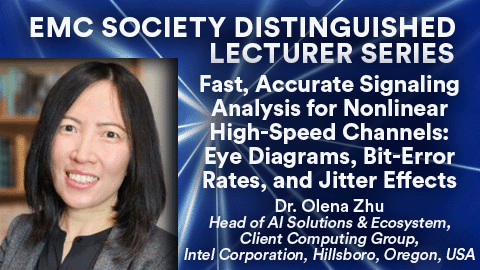
Fast, Accurate Signaling Analysis for Nonlinear High-Speed Channels: Eye Diagrams, Bit-Error Rates, and Jitter Effects
Speaker Bio:
Dr. Olena Zhu
Head of AI Solutions & Ecosystem, Client Computing Group, Intel Corporation
Hillsboro, Oregon, USA
Abstract:
As high-speed interconnects continue scaling in data rate, channel complexity, packaging effects, and nonlinearities, designers face growing difficulty in accurately predicting signal integrity, worst-case eye diagrams, bit-error rates (BERs), and the impact of jitter. Traditional linear time-invariant (LTI) or exhaustive brute-force nonlinear simulation methods become prohibitively expensive or inaccurate for high channel memory and stringent BER targets. Relying on AI approaches only, such as Bayesian Optimization, also cannot deliver efficient and practical solution.
This presentation unifies three recent advances toward fast, accurate signaling analysis in nonlinear high-performance channels:
Efficient Eye-Diagram Prediction via Low-Rank Approximations –a method that treats the set of responses of an m-bit memory nonlinear channel as a matrix whose columns correspond to the outputs under different preceding bit patterns was developed. By observing that for a reasonable prescribed accuracy the number of distinct waveforms (i.e. the effective rank, k) is much smaller than the full 2ᵐ possibilities, then a fast cross-approximation algorithm was developed, whose time/memory complexity is independent of 2ᵐ. This allows accurate identification of worst-case eye height and width with vastly fewer nonlinear simulations than brute force or Bayesian Optimization.
Fast BER Analysis for Nonlinear Systems – Building on the low-rank framework, we further developed a method to compute Bit-Error-Rates (BERs) of nonlinear circuits with high channel memory (m large) without exhaustively enumerating 2ᵐ input patterns. Only about O(k) nonlinear simulations are needed, where k ≪ 2ᵐ, to approximate the probability density function (PDF) of the nonlinear received signal. The method also includes error quantification so that the prediction of BER (even extremely low, e.g. 10⁻⁵⁶) comes with confidence. Real-world large-scale examples show orders-of-magnitude speed-ups with maintained accuracy.
Signaling Analysis Including Jitter Effects – Our most recent work extends the signaling analysis framework to include the effects of jitter in nonlinear high-performance channels. It provides a methodology for incorporating both deterministic and random jitter, quantifying how timing uncertainty interacts with channel nonlinearity and inter-symbol interference (ISI), and assessing its impact on eye-opening, worst-case eye distortions, and BER under more realistic conditions. This step is essential for bridging gap between idealized channel models and what is observed in real silicon/packaging/board environments.
These combined techniques enable practical, rigorous SI/PI/jitter analysis for next-generation high-rate I/Os (e.g. DDR, SerDes, DRAM, interposer links), where budgets are tight and nonlinearity + jitter can no longer be treated as small perturbations. Future work may extend in several directions: multi-channel interactions (more aggressors / crosstalk), adaptive equalization, dynamic jitter/noise sources, and real-time / in-design tools embedding these fast approximations.
Speaker Bio:
Dr. Olena Zhu is the Head of AI Solutions & Ecosystem in Intel’s Client Computing Group, where she leads Intel’s strategy for AI-enabled client and edge computing platforms. She drives the development of multi-agent, hybrid on-device/cloud AI solutions, including the Intel AI Assistant Builder, and builds strategic AI ecosystems with partners such as Microsoft, Mistral, and Perplexity. Her work focuses on transforming PCs and edge devices into agentic, intelligent platforms, accelerating practical AI adoption across consumer and enterprise environments through tightly integrated hardware–software–AI co-design.
Previously, Dr. Zhu served as Chief AI Technologist for Intel’s Client Computing Group, where she initiated and led Intel’s corporate-level Augmented Intelligence (AuI) strategy—combining domain expertise with machine intelligence to transform end-to-end design methodologies. She led the development of AI-driven optimization solutions spanning silicon, package, board, and system design, achieving over 90% reduction in design cycle time with corporate-wide adoption. Her technical contributions include AI-assisted auto-overclocking for Intel’s 14th Generation CPUs, personalized PC optimization for performance and power efficiency, and high-dimensional global optimization algorithms achieving 2× speedup over prior approaches. Earlier roles at Intel include Principal Engineer for the Intel Evo™ platform, System Architect, and Technical Lead, where she delivered major advances in battery life, power management, low-power architectures, high-speed I/O design, and ML-enabled nonlinear circuit simulation.
Dr. Zhu received her Ph.D. in Electrical and Computer Engineering from Purdue University and her B.S. in Electronic Engineering from the University of Science and Technology of China. She has authored 50+ journal and conference publications in computational electromagnetics, signal and power integrity, and AI-driven system optimization, and holds 40+ granted or pending U.S. patents. Her work includes foundational contributions to full-wave electromagnetic solvers, nonlinear signaling analysis, and EMC/SI modeling, published in leading IEEE journals. She is a recipient of the Intel Achievement Award and the SWE Emerging Leader Award, has served as Industry Chair for an IEEE MTT-S conference, and is an active mentor and leader within the global engineering and research community.
.
Date: Wednesday, August 26, 2026
Time: 4:00pm – 5:30pm (EDT)