


- This event has passed.
EMC Society Distinguished Lecturer Series: Can You Identify an Electromagnetic Photo? – EMC Analysis Enhanced by Artificial Intelligence
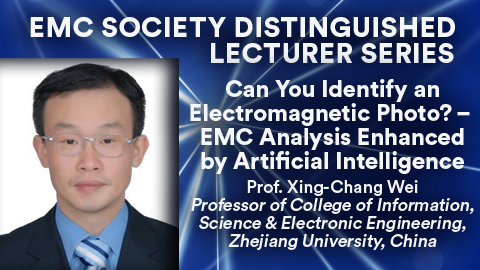
Can You Identify an Electromagnetic Photo? – EMC Analysis Enhanced by Artificial Intelligence
Speaker Bio:
Prof. Xing-Chang Wei
Professor of College of Information, Science & Electronic Engineering, Zhejiang University, China
Abstract:
In recent years, the artificial intelligence (AI) technology provides a powerful tool for solving electromagnetic problems, and there has been many successful stories for their applications on microwave device and antenna designs. The radiated near-field can be taken as an electromagnetic photo of an unknown EMI radiation source. This photo contains a lot of intrinsic information about the radiation source, such as its 3-meter radiation, coupling characteristics with nearby sensitive devices, as well as information about the position and polarization of the radiation source itself. But due to the inability of the human eye to see electromagnetic waves, our ability to identify electromagnetic photos is much lower than that of ordinary photos. AI has achieved significant results in facial recognition. This allows us to use AI to process electromagnetic photos and extract the useful information for EMI analysis from the features of the photos, such as 3-meter far-field and far-field radiation pattern.
This talk will start with a brief overview of AI and its applications in the EMC area. Then several different ways to enhance the near-field scanning by AI are presented. The Green’s function hybrid with artificial neural network (ANN) is developed for EMI estimation. The Green’s function of a dipole array with fixed source points is taken as input and the radiated field at any given observation point is taken as the output of ANN. We use the powerful mapping ability of ANN to replace the matrix-vector multiplication between Green’s function and dipole moments in the traditional dipole model, so that the ANN can be used to predict the near-field from unknown EMI source. Next, a deep convolutional neural network (DCNN) hybrid with the plane wave spectrum is proposed. By leveraging plane wave expansion, the spatial magnetic near-field data are converted into the spectrum domain, serving as the input for the DCNN model. DCNN’s output is the 3-meter electric far field. It enables the output of DCNN (3-meter far-field) insensitive to variations in the near-field scanning height. Finally, the physics-informed neural network (PINN) is introduced for near-field prediction, where the wave equation is integrated with the deep neural network. Therefore, the PINN is capable of efficiently interpolating and extrapolating the scanned near-field fields.
Speaker Bio:
Xing-Chang Wei received the Bachelor, Master, and PhD degrees in the electromagnetic field and microwave engineering from Xidian University, China, in 1995, 1998, and 2001 respectively. From 2001 to 2010, he was with the A*STAR Institute of High Performance Computing, Singapore, as a Research Fellow, Senior Research Engineer, and then Research Scientist. He was the visiting scholar of University of Illinois Urbana-Champaign in 2015. In 2010, he joined Zhejiang University, China, as a Full Professor.
His main research interests include near-field scanning, power integrity (PI), and electromagnetic interference (EMI) simulation and testing. He has more than 20 years research experiences of the electromagnetic compatibility (EMC) modeling and design of the high-speed printed circuit boards and packaging. He has authored one book, a book chapter, and about 200 papers published in IEEE Transactions and IEEE international conferences. He received the 2007 Singapore Institution of Engineers Prestigious Engineering Achievement Award for his contribution on the development of the reverberation chamber, and New Century Professional Award from China Ministry of Education in 2010.
He was an IEEE senior member since 2009, and Associate Editor of IEEE Transactions on Electromagnetic Compatibility. He contributed to EMCS/IEEE in several related international conferences, and received the 2019, 2021, 2022 and 2023 Distinguished Reviewer of the IEEE Transactions on Electromagnetic Compatibility. He was the Co-Chair of the Technical Program Committee of 2010 IEEE Electrical Design of Advanced Packaging and Systems Symposium (EDAPS), Technique Paper Co-Chair of 2018 and 2020 IEEE International Symposium on Electromagnetic Compatibility & Asia-Pacific Symposium on Electromagnetic Compatibility (APEMC), and Program Chair of 2012 APEMC. He severed as the TPC members of APEMC and IEEE Workshop on Signal and Power Integrity (SPI) since 2010 and 2015 respectively. He also organized more than 10 workshops/special sessions with EMC topics on APEMC, International Workshop on the Electromagnetic Compatibility of Integrated Circuits (EMC Compo), IEEE International Conference on Computational Electromagnetics (ICCEM), and other conferences since 2011.
His supervised students obtained Best Student Paper Award in 2019 EMC Compo and 2022 APEMC, Young Investigator Training Program in 2017 SPI, Second Student Paper Award in 2016 IEEE MTT-S International Wireless Symposium, Outstanding Paper Award in 15th International Conference on Electronics Packaging Technology (ICEPT), Best Symposium Paper in 2012 APEMC, and Engineering Degree Award issued by China National Graduated Education Steering Committee for Professional Engineering Degree.
Date: Tuesday, July 21, 2026
Time: 10:00pm – 11:30pm (EDT)
(10:00am – 11:30am on Wed July 22nd at China Standard Time)